
Why Going Green Shouldn’t Cost You a Penny Upfront - And How the Savings Pay for Everything.


I hear the same concern from almost every homeowner I speak to. They understand the logic - solar, heat pumps, batteries. They can see the savings. But the moment the conversation turns to cost, the shutters come down.
“We can’t afford to spend £10,000 or £15,000 right now.”
And I completely understand that. Most families can’t. And they shouldn’t have to.
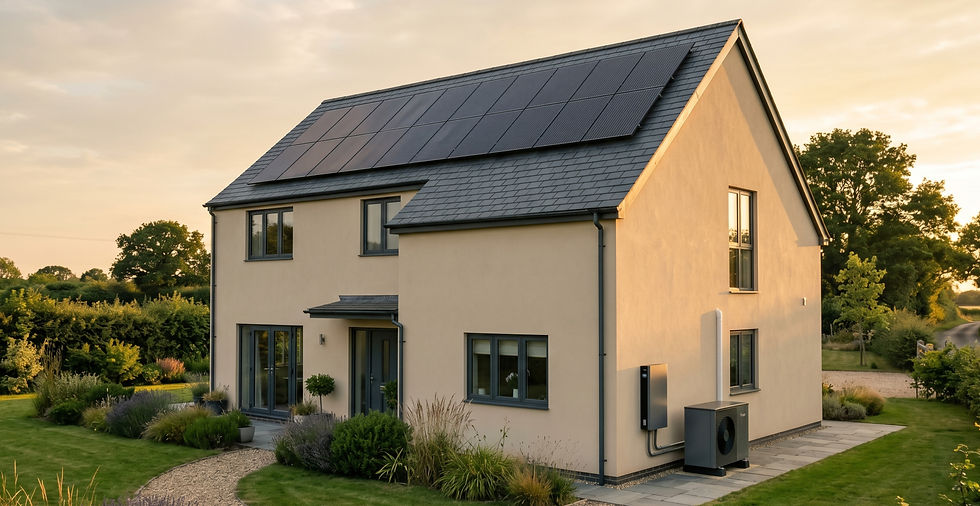
The model that Mee Energy was built around is fundamentally different: you should be able to access the full benefit of a renewable energy system with zero money out of your pocket on day one. And the savings the system generates should be large enough to cover the cost of the finance throughout the entire payback period. That’s not a marketing promise - it’s arithmetic.
Green Finance Has Changed the Game
The UK green finance market has matured significantly in the last few years, driven by government policy, lender competition and a growing recognition that energy-efficient homes are better credit risks. The result is a range of low-interest green loans specifically designed for renewable energy installations - often at rates well below standard personal loan rates, sometimes as low as 0% in the right circumstances.
These aren’t payday loans dressed up in green clothing. They are purpose-built financial products that recognise a fundamental truth: a home with solar, a heat pump and a battery is a fundamentally different financial proposition than one without. It generates income, reduces outgoings and insulates its owner from energy market volatility. Lenders are increasingly pricing that reality in.
The key principle is simple: the interest on your green loan should be less than the savings on your energy bill. If that condition is met - and with current energy prices and current loan rates, it is increasingly easy to meet - then you are better off from the very first month. Your bills go down by more than your loan repayment goes up. You are net positive from day one.
The Savings Are Doing the Heavy Lifting
Let me give you a realistic example. Take a typical semi-detached home in England. The household currently spends around £2,000 per year on energy. With the new gas and electricity price rises, that’s heading toward £2,400.
We install solar panels, a battery, and a heat pump. We put them on a green loan at a competitive rate over ten years. Their monthly repayment is, say, £120. But their energy bills drop from £200 a month to under £60 - a saving of £140 or more per month. Their loan costs £120. Their saving is £140. They are £20 a month better off before the loan is even paid off.
And that gap widens every year, because energy prices trend in one direction while their loan repayment stays fixed.
Green Home Rewards: Cash in Your Account
But the financial picture doesn’t stop at reduced bills. A number of green home reward programmes - offered by energy suppliers, local authorities, and government-backed schemes - put real money back into homeowners’ bank accounts as a reward for upgrading to cleaner, more efficient technologies.
These rewards can take several forms: cashback on qualifying purchases, grants toward installation costs, enhanced export tariffs for solar energy sent back to the grid, or loyalty credits from energy suppliers who value customers with smart, flexible energy assets.
At Mee Energy, we identify every reward and incentive your household is eligible for before we design your system. In many cases, these rewards can cover a meaningful portion of the overall cost, reducing the loan amount needed and accelerating the payback period further.
The combination of green finance and green rewards means that, in many cases, the net upfront cost to a homeowner is not just zero — it is actually negative. The system that saves you money for decades costs you nothing to begin with and puts cash in your account when you install it.
This Is About Access, Not Just Economics
I want to be honest about why this matters beyond the numbers. For too long, the green transition has been accessible primarily to people who already had capital — homeowners with savings, with equity to draw on, with the financial cushion to make a large upfront investment. That is fundamentally unjust, because the households who would benefit most from lower energy bills are often the ones least able to afford the upfront cost.
Zero-upfront green finance changes that equation. It says: you don’t need to have money to save money. You just need the right advice, the right products, and the right partner to put it together for you.
That is what Mee Energy exists to do. We are not just a technology company. We are a financial navigator, making sure every homeowner who talks to us understands exactly what they qualify for, what it will cost, what it will save, and how the numbers stack up across the full life of the system.
The Conversation That Changes Your Finances
Most homeowners who come to us expecting this to be out of reach leave that first conversation genuinely surprised. The numbers make sense in a way they didn’t expect. The finance is more accessible than they imagined. The rewards are more generous than they knew.
With energy prices rising sharply, the case for acting now rather than waiting is stronger than ever. Every month you delay is a month of higher bills you didn’t need to pay.
Zero upfront. Positive from month one. Rewards in your bank account.
That’s not a pitch. That’s the result of structuring this properly. Come and talk to us — and let’s show you what your numbers look like.


Comments